DISTRIBUTOR-FIRST SUPPLY PARTNER · SINCE 1999 Live · Compressed Air System

SPC Company
Compressed Air / Storage / Safety & Relief Valves / Safety & Relief Valve
Layer 03 · Storage Performance · Kingston Value · Conrader
What it is

Safety & Relief Valve

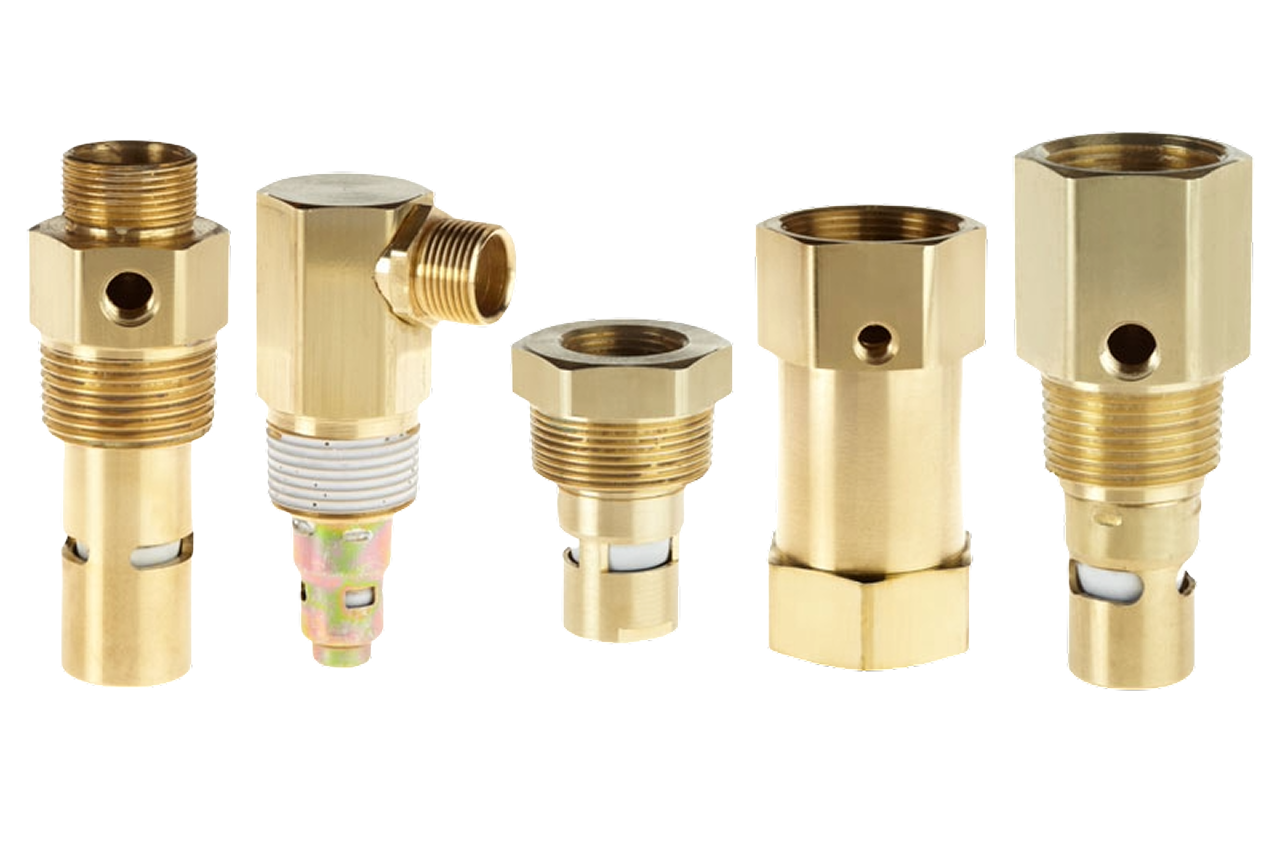
A safety relief valve is a spring-loaded valve that automatically opens and vents compressed air when system pressure exceeds a preset limit — the last line of defense against an over-pressure event. Inside the valve a spring holds a disc closed against a seat; when inlet pressure rises above the spring's set pressure, the disc lifts and air vents until pressure falls back below the set point, at which point the disc reseats. Nothing in the control circuit has to work for it to act — it responds to pressure alone, so it still protects the vessel if a pressure switch fails, a downstream valve is closed by mistake, or the compressor runs past its cut-out. It is mandatory, not discretionary: every ASME-coded pressure vessel in a compressed air system must carry an ASME-certified relief valve set at or below that vessel's MAWP. The requirement is in ASME Section VIII, OSHA 29 CFR 1910.169, and the National Board Inspection Code; an air receiver running without relief protection is an OSHA citation carrying a penalty in the five figures per violation. The category covers two distinct positions: compressor-head and discharge-side protection (small, 1/8 inch to 3/8 inch NPT), and receiver-mounted protection (1/2 inch to 3 inch NPT) sized to the storage vessel. The two positions differ in connection size and set-pressure range, which is why the category is taught as one product type with the position confirmed at quote.
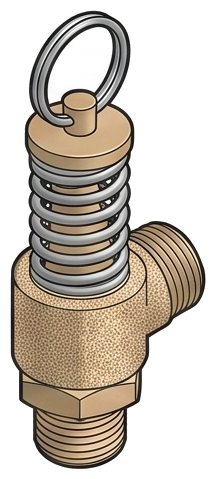
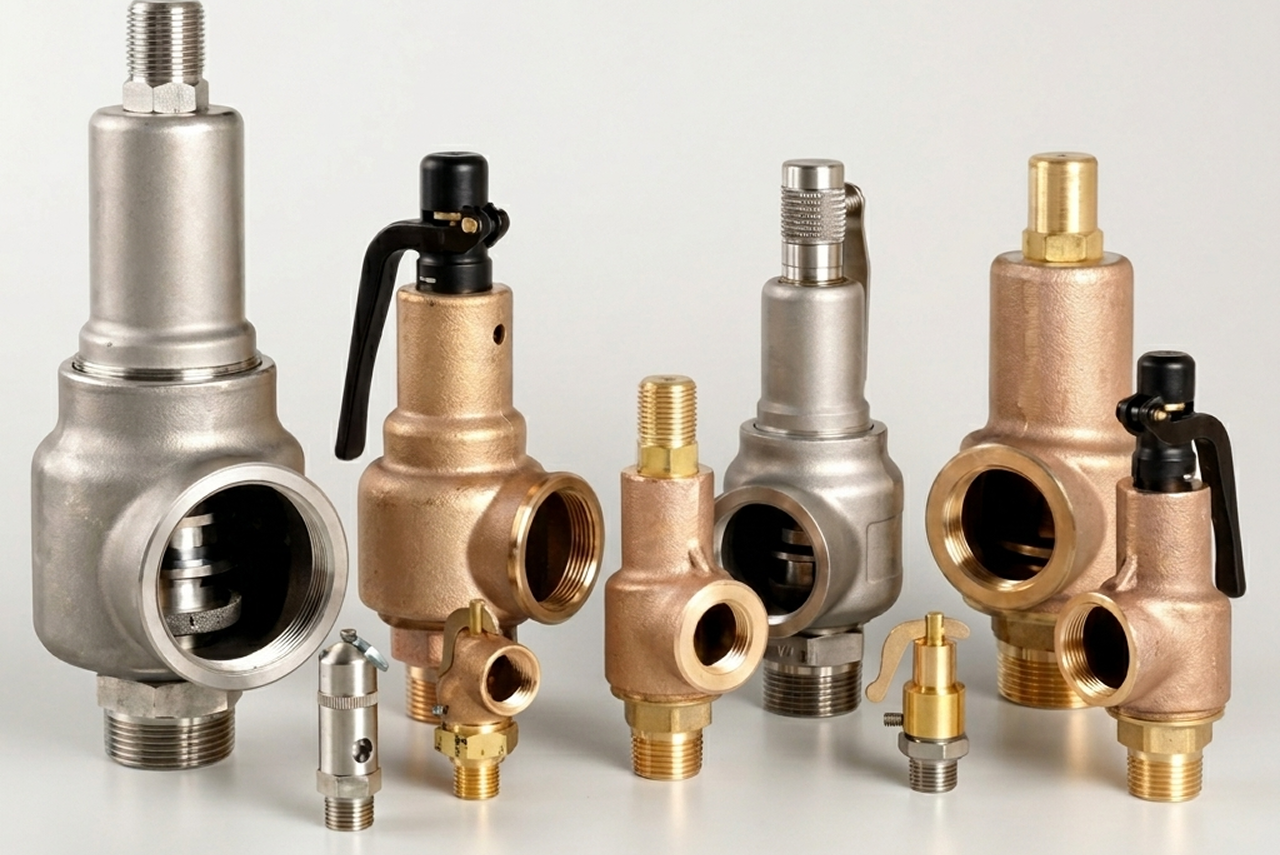
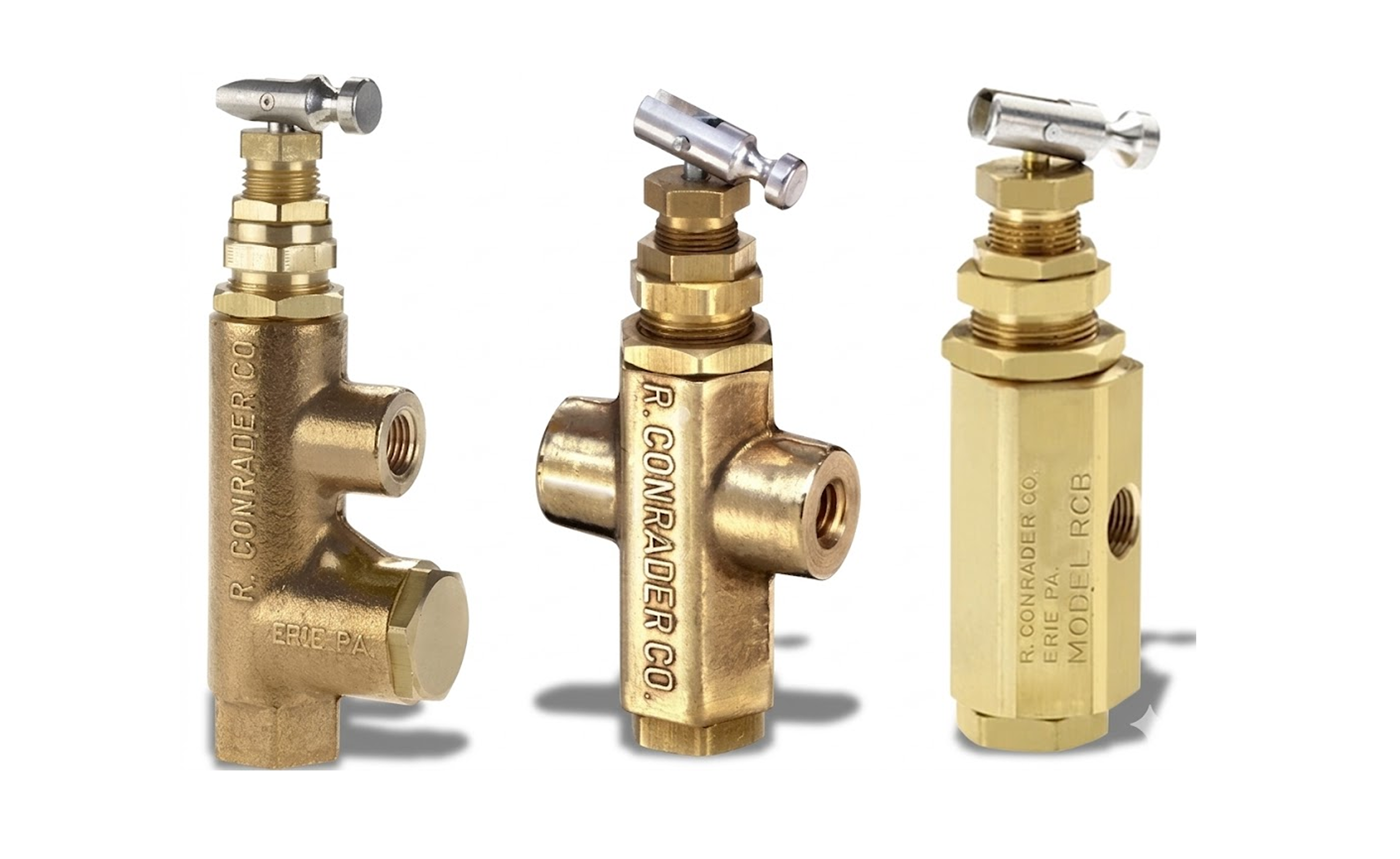
Pictorial Representative safety & relief valve
Safety & Relief Valve — representative illustration
Real-world reference Representative safety & relief valve
Safety & Relief Valve — representative product photo
Why it's needed

Why this matters.

Code-required, non-discretionary, the line every customer cannot legally skip — and the one category where "close enough" gets people killed. Scroll the strip →

01 · Key point
Code-mandated, every vessel.

ASME Section VIII, OSHA 29 CFR 1910.169, and the National Board all mandate an ASME-certified relief on every receiver and every positive-displacement compressor discharge ahead of any shutoff. Running without one is a five-figure-per-violation OSHA citation.

02 · Key point
It doesn't need anything else.

Pressure switches weld shut. Unloaders stick on varnish. Isolation valves get closed with the compressor running. The relief responds to pressure alone — it still protects the vessel when every other control has failed. Last line before a ruptured receiver, which is a fragmentation event, not a leak.

03 · Key point
Receiver AND compressor, both.

The receiver valve protects the tank; the compressor-discharge valve protects the compressor if a downstream isolation closes with the machine running. Aftercoolers, inter-coolers, and any ASME-stamped vessel in the train all require their own relief sized to upstream SCFM.

04 · Pro tip
Read MAWP, match SCFM, verify stamp.

Set pressure at or below vessel MAWP from the ASME nameplate — never above. Relieving capacity equal or exceed full compressor SCFM from the compressor nameplate. Verify UV stamp and National Board number on the body or cert tag before install. Common stocked set points: 100, 125, 150, 175, 200, 250 PSI.

05 · Where not to use
Non-ASME "lookalike" valves.

Import-tier valves without the UV stamp fail the next inspection, void insurance, and create legal exposure on a wrongful-death event. Never a legal substitute on a code vessel.Re-spec to ASME UV-stamped relief with National Board number.

06 · Where not to use
Undersized for compressor SCFM.

The failure mode that has killed people. Disc lifts but cannot vent fast enough — vessel over-pressures while the valve sits useless. Capacity must equal or exceed full-load compressor SCFM.Step up port size and capacity to match upstream output.

07 · Where not to use
Weeping valve left in service.

A weeping or partially-open valve has failed and is no longer code-certified. Manual lift sometimes clears light debris; continued weep means it stays open during normal ops. → Replace immediately; never re-spring or adjust set pressure — any modification voids the ASME cert.

Key selection criteria

What we need to spec it right.

From the machine spec sheet to the part number. Answer what you know, leave the rest blank, and send.

Answer what you know, leave the rest blank, and send. Need different sizes, colors, or quantities? Configure, add to quote, then configure again. Each click is one quote line.

04Choose your priority  ·  core differentiator

Whatever your lever — performance, value, or price — SPC has the right brand.

Pick the priority; the quote desk handles the cross-reference.

01 Performance 1 brand
02 Value 1 brand
05How to sell this  ·  distributor talk track

The tier conversation closes the deal. The cross-reference catalog wins the next one.

Code-required, non-discretionary, the line item every customer cannot legally skip. Never let one leave a compressor or tank quote without it.
The SPC difference · how distributors actually buy

The 30-second positioning

Safety relief valves are the easiest yes in the aftermarket — the customer has zero ability to refuse them. ASME Section VIII, OSHA 1910.169, and the National Board do the selling. The conversation is "what set pressure, what connection size, and add the annual test-and-tag while we're at it?" Cadence: annual lift test, 3-5 year proactive replacement, immediate on any failed test or weeping seat.

Brand tiers. Industry Leader tier for both compressor-service and receiver-mounted — full UV stamp, National Board cert, consistent stocking on common set points. Emerging tier ASME-certified at lower prices, slower on uncommon set pressures. Economical / import-tier non-ASME: never appropriate on a code vessel. The relief valve is the one category with no economical tier.

Recurring revenue. $30-$80 compressor-head, $80-$300 typical receiver. Attach rate is universal — every receiver, every compressor, every PM. A fleet of 5 receivers + 5 compressors generates $500-$2,000/year on replacements and lift-test labor.

Customer cue → talk move

"Came as a package — we don't need to do anything"
Confirm UV stamp and current lift-test tag. Import-tier packages sometimes ship uncertified. Annual test is OSHA-required regardless of age.
"Weeping a little — is that normal?"
No. A weeping valve has failed and is no longer code-certified. Manual lift sometimes clears light contamination; continued weep means replacement.
"Dumped the whole tank — what happened?"
Something upstream let pressure climb past set point. The relief did its job. Walk pressure switch, unloader, downstream isolation. Replace the relief if leaking after the discharge (common).
"What set pressure?"
Vessel MAWP from the nameplate, and existing valve tag if replacement. At or below MAWP, never above. Replacement: match exactly. New install: closest standard set point not exceeding MAWP.
"OSHA inspection next week, no current tags"
Schedule lift-test-and-tag immediately. Any valve failing the test gets replaced before tagging.
"Receiver vs. compressor — both?"
Yes, almost always. Receiver valve protects the tank; compressor discharge valve protects the compressor itself if a downstream isolation closes with the machine running.
"Whole bank or just one?"
On service-route relationships, lift-test the whole bank in one PM visit; replace any that fail, weep, or are within 12 months of the 3-5 year cadence. Bundle onto one shipment.
Where it's used

Industries served.

Each industry below uses this product across the listed areas. Open an industry to see how it fits the rest of its system.

Also applies to Air receiver tanks (horizontal and vertical, all sizes) · Reciprocating compressor discharge (head and inter-stage protection) · high-temperature (300-400°F service) · Rotary screw compressor discharge protection · The most predictable recurring revenue line in the category

Install · 6 critical steps

The things that matter on the first install.

Step 01
Confirm set pressure, connection, and ASME cert before purchasing
Read vessel MAWP from the ASME nameplate and compressor full-load SCFM. New valve's set pressure at or below MAWP; relieving capacity equal or exceed compressor SCFM. Verify UV stamp and National Board number on the body or cert tag. Replacement: match existing connection and set pressure exactly.
Step 02
Depressurize and lock out
Stop the compressor, vent the receiver to 0 PSI, lock and tag out the disconnect. A relief valve removed from a pressurized vessel becomes a high-velocity projectile — no shortcuts. Confirm 0 PSI on the gauge before touching the valve.
Step 03
Remove the old valve and inspect port threads
Wrench on the flats (not the body or test lever). If it fights you, penetrate and soak rather than over-torque. Inspect the port for damaged threads, scale, or corrosion — a fresh valve installed into damaged threads leaks from day one. Chase with a tap-style cleaner if needed.
Step 04
Apply sealant and torque to spec
PTFE tape 2-3 wraps in the direction of engagement, or liquid pipe sealant rated for pressure and temperature. Leave the first thread bare so debris doesn't enter the seat. Hand-thread, then torque on the flats — typically 25-40 ft-lb for 1/2 inch NPT. Over-torque distorts the body and damages the seat; under-torque leaks.
Step 05
Orient the discharge and verify clearance
Orient so an accidental lift cannot direct hot, high-velocity air at personnel or equipment. Route through a pipe nipple to point flow up or away as needed. Do not pipe discharge into a restriction or back into the air system — must remain at atmospheric pressure or the valve cannot achieve full lift.
Step 06
Pressurize, lift-test, and tag
Restart, bring to operating pressure. Listen for any seat-leak hiss — properly installed valve makes no audible sound. Soap-bubble the port connection. Pull the manual lever firmly; air should vent loudly and fully, then reseat cleanly. If it won't reseat after 2-3 tries, replace at install. Wire a metal tag with install date, set pressure, serial, next test (12 months). Calendar 3-5 year replacement.
Troubleshoot · top failures

Most returns trace to one of these causes.

Symptom
Most likely cause
Fix
Weeping or hissing at normal operating pressure
Seat fouled by debris (scale, varnish, particulate), seat or disc worn from cycling, or spring relaxed below set point.
Operate the manual lever 2-3 times to flush debris. If the weep persists, replace with same set pressure and connection. Never re-spring or adjust set pressure on a code-certified valve — any modification voids the ASME certification.
Valve opens repeatedly well below set point
Spring fatigued (rare), wrong set pressure on the replacement, or — more often — upstream pressure switch / unloader out of calibration and system pressure running close to relief at peak demand.
Verify actual inlet pressure with a calibrated gauge during full-load. If system pressure is genuinely well below set point and the valve still opens, replace. If climbing close to set point, adjust the upstream control circuit (switch differential, unloader, capacity-control).
Valve does not open during the manual lift test
Seat stuck closed from years of varnish or corrosion (most common on valves that have never been tested). A stuck-closed valve has failed in the worst possible way: it does not protect the vessel.
Replace immediately. Never force, penetrant, or spring-adjust a stuck-closed valve — once it has failed the lift test, it is no longer code-certified. Put the customer on an annual lift-test cadence to catch the same failure mode elsewhere in the fleet.
Opens cleanly but does not reseat
Debris caught between seat and disc after the lift, surface damage, or spring tension below reseat. Hard-seat (metal) is slightly more prone to debris not reseating; soft-seat (elastomer) reseats tighter but is more vulnerable to thermal aging.
Operate the lever 2-3 times to clear debris. If still won't reseat, depressurize and replace — a valve that will not reseat is no longer code-certified.
Leak at the threaded vessel port (not the valve outlet)
Insufficient sealant, PTFE tape unwound during install, damaged port threads, or wrong torque. Installation issue, not a valve failure.
Depressurize, remove, chase port threads. Re-apply sealant (2-3 wraps PTFE in the engagement direction). Re-torque on the flats. If threads are damaged beyond chaser repair, the vessel needs port repair — a welder-and-NDE (Non-Destructive Examination — the inspection method required when re-certifying repaired pressure-vessel welds) job, not a service-parts fix.
Valve sized wrong (capacity below compressor SCFM, OR set pressure above MAWP)
"Looks-close-enough" stock used at original install, compressor upgraded without revising relief, or vessel replaced with lower-MAWP unit without re-sizing.
Replace immediately with correctly-sized ASME valve. Set pressure at or below MAWP; capacity equal or exceed full compressor SCFM. An undersized valve fails open the worst way possible — disc lifts but cannot vent fast enough, vessel still over-pressures while the valve sits useless. This is the scenario that has killed people; it is the one to never get wrong.

Get the right safety & relief valve on quote in 24 hours.

Send us the application — a specialist routes you to the correct tier with a configured part. Lead-times and pricing returned within one business day.

Request a quote