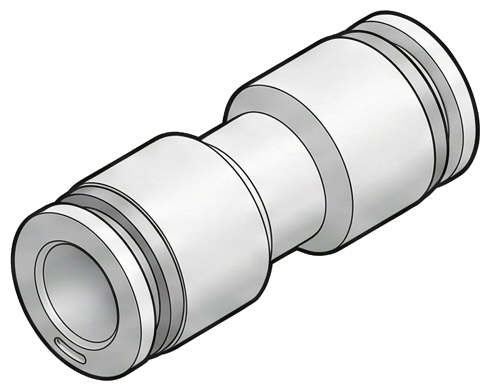
What it is
The everyday tube-to-port connection
Tool-free push-to-connect — the highest-volume fitting in any pneumatic plant, and the deepest line a distributor stocks.

Five push-to-connect tiers, one material decision. What's the pressure and temperature, what does the connection touch, and what audit applies? This page walks the spec from composite — the workhorse for general plant air — up through brass, stainless, technopolymer, and NSF food-grade. Comparison table first, decision branch second. Push-to-connect is SPC's deepest brand cell, anchored on Sang-A's 20+ years as the flagship.
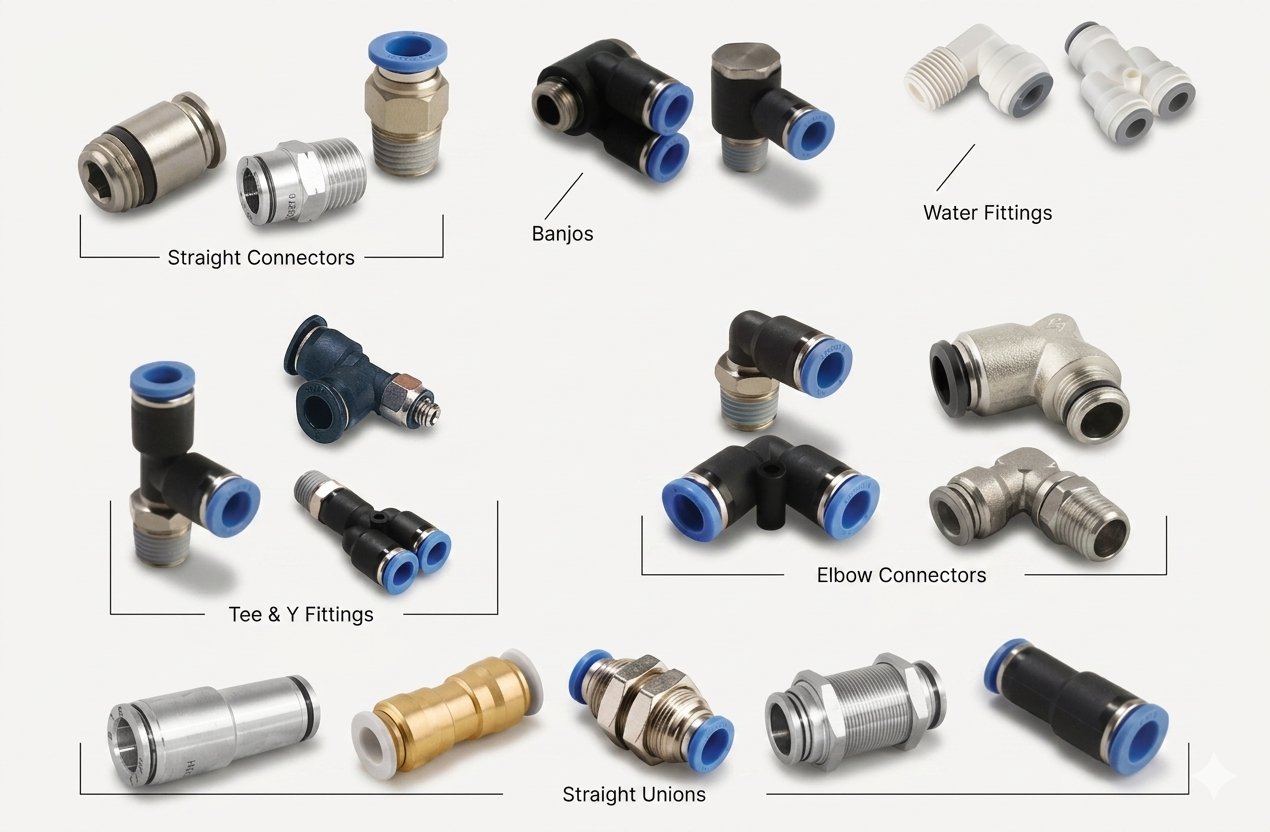
Tap any type to jump to its page. The Decision Guide further down asks three questions that funnel the spec to one of these.
Tool-free push-to-connect — the highest-volume fitting in any pneumatic plant, and the deepest line a distributor stocks.
Five tiers — composite, brass, stainless, technopolymer, NSF food-grade. You're matching a material to a service, not a brand to a budget.
What does the material need to tolerate, what audit applies, and what does a failure cost? Answer those three and the tier falls out.
Audits put 20-30% of a plant's compressor output lost to leaks — most of it at fittings and joints, not the equipment.
Above that — or in oil, sustained heat, or aggressive chemistry — step up to brass or stainless. Cheap collets creep under vibration.
20+ years as SPC's flagship connection brand — deepest stock on composite and brass PTC; cross-listings cover the spec edges.
Distributor-facing reading. The trade-off column is the one that closes the loop — every type buys something and gives something up. Knowing what each type costs you is how the right one gets on the quote without a callback.
Reading the brand bench column — the bar shows how many of SPC's tier slots (Industry Leader · Emerging · Economical · adjacent) carry an option at that product type. Push-to-connect is the deepest brand cell in the Pneumatic Automation system, but the depth lives at the product-type level — most individual PTs run 1-3 brands deep because the specs are narrow (one Aignep here, one Alkon there). Sang-A is the anchor brand — 20+ years as SPC's flagship pneumatic connection brand, deepest stock positions in the building on composite and brass PTC. Cross-listings to Aignep and Alkon cover the stainless, technopolymer, and NSF spec-driven edges Sang-A doesn't carry.
Draw a line from the customer's answer at the top to the type name at the bottom. This is the page distributors screenshot and send to a customer the day before a quote call — so the customer comes prepared with the answers, and the call is about the brand and the budget, not the basics.
Distribution is the layer that turns a treated, regulated air supply into air at the actuator — and the layer that's invisible when it works and catastrophic when it doesn't. Every leak, every pressure drop, every blown hose, every machine-down call traced back to "the air just stopped" ultimately lives in this layer. A pneumatic system is a thousand-plus connections — header to drop leg, drop leg to FRL, FRL to manifold, manifold to valve, valve to cylinder, plus every hand-tool coupler in between — and each one is a candidate failure point. Industry audits consistently put facility-wide leak rates at 20-30% of compressor output, with the majority of those losses at fittings and joints, not at the equipment. Distribution is also where material spec meets regulatory and audit exposure — food contact, NSF certification, ATEX classification, DOT/FMCSA brake circuits, B31.3 instrumentation. Spec it right at the connection level and the rest of the system can deliver what it was designed to deliver; spec it wrong and the customer is patching leaks for the life of the plant.
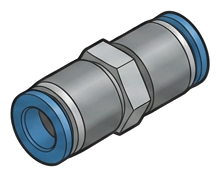
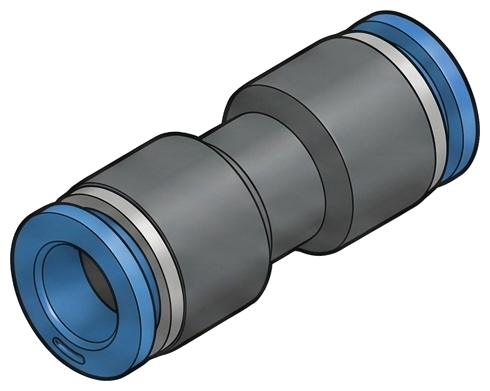
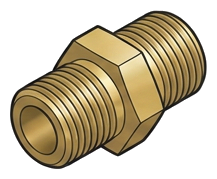
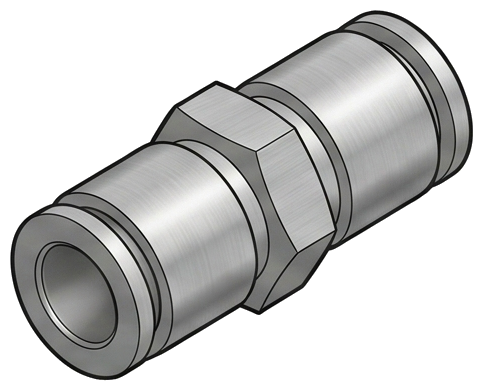
Five push-to-connect tiers graded by body material and certification — composite, technopolymer, brass, stainless, NSF food-grade. The Sang-A flagship core of the Distribution layer.
Push-to-connect bodies that also perform a function — rotary joints and stop fittings. The Sang-A functional-fitting line.
→A different fitting family from push-to-connect — instrumentation double-ferrule for high-purity and DOT for commercial-vehicle brake circuits.
→The line itself — PE, PU, nylon, and FEP/PTFE matched to chemistry, pressure, and motion. The tube the fitting connects.
→Tool changeover at the hose end — industrial, safety, and plug halves for hand-tool drops.
→The plant header — extruded aluminum mains replacing legacy black iron, upstream of every fitting drop.
→Downstream in Control & Valving — the valves the fitting-and-tube run ultimately feeds at the manifold.
→Tell us the end-use, the rough flow, and what climate the unit would sit in. We'll come back with a configured quote — the right type, the right tier, and the upstream gear the warranty assumes.
—. We reply within one business day with pricing, lead-time, and configured parts.